Every fan knows…
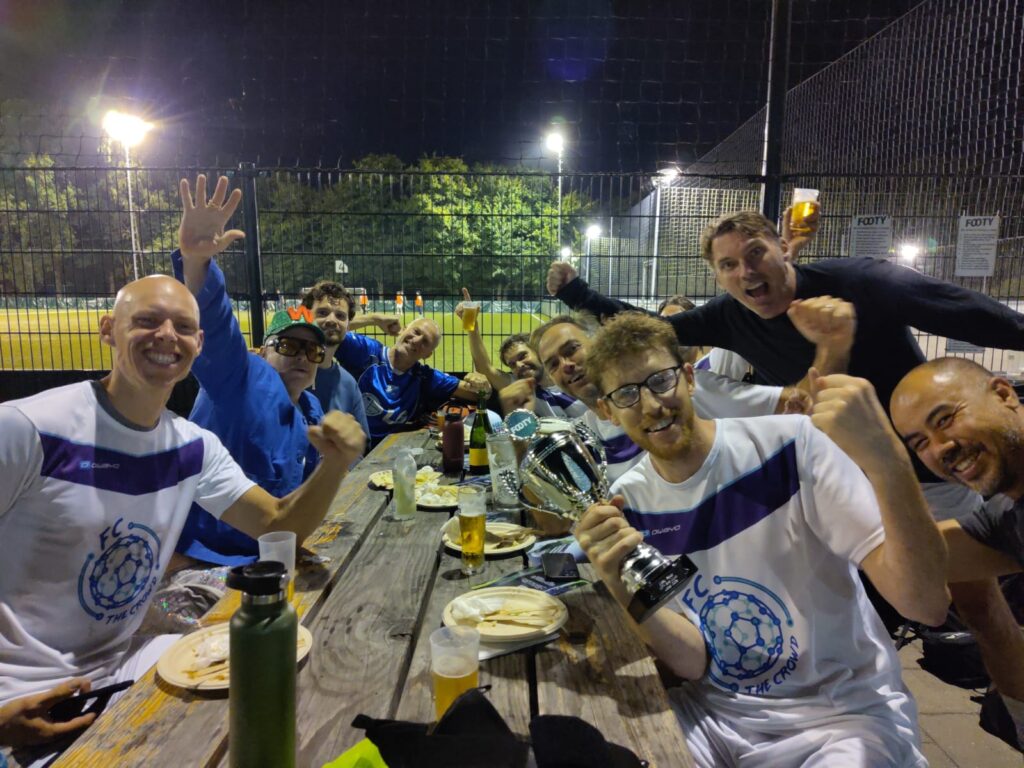
Standing on the pitch yourself is, of course, the best thing there is, but the “third half” (post-match drinks) with your team in the clubhouse comes in a very close second, literally and figuratively. That sense of belonging while enjoying a drink is wonderful; it’s the place where we over-analyze our own match to figure out how to improve together. And when there’s a great game on the big screens, the picture is complete: watching football together and fanatically exchanging opinions about the pros is the perfect end to the day.
While watching, frustrations inevitably bubble up. We often disagree on the tactics or the players, but sometimes the sentiment is shared and crystal clear. That’s when the coach really gets roasted.
Behavior is another frequent source of frustration. Why on earth would you try to shield the ball at the corner flag? It’s embarrassing. And don’t even get us started on time-wasting. Or does that change when your team is ahead? Either way, the “role model” discussion always comes up.
The frustrations aren’t just about the highs and lows of our “own” clubs, either. The rules and refereeing come up too. Even though VAR has settled some issues, the disagreement over certain decisions remains as deep as ever.
And if we look even further, the world of football becomes a far-away show. How the football world is run by megalomaniac lunatics is bizarre. Some corrupt clown who sees himself as a peacemaker in Gaza now hands out world peace prizes on behalf of 5 billion people. And you can’t even accuse him of corruption, because that word has been taken out of the “code of conduct.” Where would we be without him…?
It was during one of those third halves… where everyone in the clubhouse saw a player drop below the performance baseline but the coach didn’t substitute him; where one team tried to hold the ball at the corner flag, only to lose it 20 seconds later; where a player rolled around ten times but the VAR didn’t notice it was theatrics; where FIFA miraculously ended up with Saudi Arabia as the only remaining candidate for the World Cup… during one of those third halvess, that things reached a climax. And an idea was born.
Real-Life Football Manager, Together
We all think we know better as fans… so what if we could combine our opinions in a way that leads to policy and action? What if we could crowdfund, crowdmanage, and crowdsource a professional football club through a paid membership? Then we’d all be football managers in real life. How cool would that be!? And technically, it should be feasible nowadays.
Together we know more, we do things better, and we stand stronger. If we reach enough mass, there will always be someone with the right idea. Always someone who realizes you should swap your keeper right before the end of extra time. And we would never sub a world-class attacker who is in the zone for a middle-class midfielder 30 minutes before the end ;-).
And even if we don’t know better… there are countless examples of professional decisions that could hardly be worse. On average, we should be able to do at least as well. Even then, it’s a pure win that we’re doing it together, knowing exactly what’s going on and actually holding the reins. Then those third halves really mean something!
Additionally, there are more benefits to running a club with members, such as financial stability and greater appeal for sponsors and businesses. Win-win-win!
As you can imagine, this idea became the main topic of the third half. At the same time, my work contract wasn’t renewed, giving me time to work on a plan…
That plan was super simple: if we all chip in a little bit of money, we can try it for a few months. If everyone who joins does the same, the plan pays for itself and we instantly have social proof. If we can’t get people on board, we prove it wasn’t such a good idea after all. Then we can move on with our lives, without doubt or regret, and just go back to enjoying (occasionally frustrated) football watching as always.
The plan was solid, we put the money in, but we saw one major problem: who is going to join four middle-aged white guys (who, in their own opinion, can still play a decent game) wanting to turn the football world upside down?
To solve that, we wanted to recruit a “starting eleven” of top players, with each player representing a specific field of football or business. The only requirement was that they were proven experts in their field. A top marketer for the marketing, a financial guy who’s been there before, a programmer who has developed fantastic products, a well-known face for the campaign, a top lawyer, etc. And most importantly: a big name from the football world to commit to the cause. All with the idea that if it truly is a great plan, it will finance itself.
Act One: Everything Starts with a Two-Pager
Just as every football club strives for the highest possible level, we decided to start with the biggest names in football. Through connections, we were able to present our plans via a two-pager to one of those big names. And, because it’s such a good plan ;-), it actually worked.
Before we knew it, thanks to that big name, we had a starting eleven of nothing but top-tier experts on board. Where we initially dreamed of just any professional club, we were now dreaming of a European sub-top contender. We couldn’t believe our luck. This all culminated in a final go/no-go meeting, where we all decided to go for it. We would set up a company, invest the money, and the rest would be history.
But sometimes things are too good to be true, and it’s only final when it’s in writing.
From the start, there had been some doubt from the “professional football” side about whether you can just give power to the members. Because what do they know? I thought I had convinced them that people with deep football knowledge could share it so we could all make informed decisions. We spent seven months refining the plans with that in mind. In the end, though, they still wanted to call the shots. They believed they had the best vision and the most to lose (in terms of reputation, as financially we were all only investing a modest 5,000 euros).
Holding power in a small inner circle, however, is so far removed from the core idea – that we are stronger together and that influence shouldn’t be bought – that I couldn’t go on motivated. Even though the dream had grown bigger than I ever dared hope, we pulled the plug. Since everyone was doing it as a passion project for a few hours a week, the whole plan collapsed instantly.
One dream poorer and one loan richer (I had to borrow from my girlfriend – thanks, babe! – to bridge the final months of the project and the time until my next job), I was grateful for a harsh winter. In three days, I managed to “ice-skate off’ the frustration about how the project went, the sense of failure, and the doubt if I’d done the right thing. But the idea and belief didn’t go away.
Had we not actually proven that it was a strong plan? Maybe we needed to try it again in a different way…
Act Two: Football Grassroots
Just before everything collapsed, I had contacted the people at Flavour. They apply (digital) gamification to create impact in the real world. Exactly what we wanted to achieve.
When I called Emily, it turned out they had been walking around with EXACTLY the same idea. They had not only thought about it, but tried to set it up too. Because they had connections in the media world, they tried that angle.
Like us, they quickly had multiple parties at the table, but they hit the same wall when it came to putting things on paper. One felt they had more rights than another; another felt their name was the most important. In short, ego, as it so often does in our society, stood in the way of collaboration.
When Emily and I first spoke, there were already doubts about whether my project would continue, but we decided to keep in touch. Great ideas keep their attraction.
After a four-month cooling-down period while I looked for work, I called again and we agreed to meet. Everyone still involved (“De Bengels”, the name of our team — derived from VV De Beursbengels where we met — and Team Flavour) all felt the same: this idea has a right to exist and should happen — even if as a (football!) grassroots movement.
The problem we encountered in our previous attempts was that the structure hadn’t been set in stone yet. Because nothing was in writing, egos flared up—intentionally or not.
We decided to avoid that by first defining the structure on paper, then everyone who wants to join can do so immediately. Anyone who only wants to join on their own terms can stay away. We have no use for people who don’t believe in the power of real collaboration and aren’t willing to compromise.
After some time and discussion, we quickly knew how we wanted it on paper. Equal say for every member was a must. We also needed a structure where the first members, the true pioneers, would be rewarded the most; there needs to be a sense of urgency and reward for effort and risk to get people moving.
An association (Vereniging) is the perfect form for the first part. However, raising money and rewarding people is harder that way. That’s why, alongside our association, we also founded a cooperative (Coöperatie) through which we raise money by selling certificates. Those certificates give you status, not influence. And because they will become tradable (for members), there’s a small earning model. Nice if you put in money, and even nicer if you earn certificates through involvement.
Now that we had the structure in mind, the rest should be simple.
Right?
Wrong.
Setting up a cooperative is hard enough, but opening a bank account as a cooperative is a total nightmare. Especially when you’re dealing with crowdfunding and football (which doesn’t help with online payment providers either). All in all, that whole process took us over 3 years (!).
There are several reasons for this. One of them is life itself. This is a side project for everyone; in that time, I’ve had two children and moved into a new house. But waiting over a year and a half for banks because they are “too busy” or just flat-out reject you doesn’t help.
And raising money without a bank account? Impossible (unless you go the blockchain/crypto route, but that drastically narrows your audience, and we don’t think that’s where the majority of our target group is).
Looking back, we might have chosen a different structure and started with a limited company (BV), but that’s easy to say in hindsight. Bottom line: we’re now where we wanted to be, just five years later.
In the meantime, there have been plenty of downs, members have dropped out, and motivation was sometimes hard to find… but the persistent one wins — or in this case: the persistent one finally begins.
And we are in a better position than ever! Setting up the association was a breeze, so we’ve had paying members for a few years now. Recently, I’ve been able to convince some of those members to take an active role now that we can finally start raising funds. The result is a new board. In short: we have more involved members and more money in the bank than ever. And we’re just getting started. 😉
Act Three: The Fun Part Is Just Beginning
In fact, the third act begins now. So, join us and become a member of FC The Crowd. Together we can turn the football world upside down. From here the fun part begins!
— And oh yeah, we also had to change our name in between because Chelsea FC found it threatening that we initially wanted to call ourselves CFC The Crowd (Cooperative Football Club). But that’s a story for another time…
